If you’ve ever wondered what London, Ontario looked like from above in 1965, well you can wonder no more.
Similar to the composite of 1922 London aerial photos I stitched together in 2013, this one is made up of 21-or-so aerial photos taken in 1965 by Hunting Survey Corp. The photos currently reside at the Map and Data Centre in Western Libraries at Western University.
Some of the streets may not line up perfectly, as I used Autopano to automatically stitch the separate images together (it did a great job though!)
The view you see here is all that the surveying covered. Some areas of the city missing include Clarke Road, and areas around the 401, among some others.
Below is a zoomable version of the composite. You can find a larger zoomable version here.
A new year-long heritage project is hoping to change that.
With help from the City and the London Heritage Council, Roberta Santoro, a post-doc in the School of Language and Literature at the University of Guelph, aims to capture stories and memories about 31 buildings in London’s Downtown.
The goal of the project is simple:
“The ultimate scope is to revive the Downtown, but not by pulling down buildings, and erecting some big building, big hall, but by trying to shine a spotlight on what we have,” Santoro said.
The buildings chosen are ones mainly along Dundas that reflect architectural styles noted in the Conservation Plan, and ones in or around the recently proposed Downtown Master Plan.
Santoro says she wants to find stories and memories of the buildings in their pre-1970s heyday, because over the last 50 years, many buildings have been either torn-down or altered completely.
“I think London should really look at its historic core, and look to reinvent it by taking care of its heritage, because the more cities I travel to in Canada, the more I see that many cities, including Guelph, and so many other smaller cities than London, are really taking care of their heritage. They’ve restored a lot of buildings. They have a very aesthetically pleasing downtown. I’m afraid this can’t be said about London. Partly it’s because London has now, for quite a few decades, turned its back on its heritage, and it doesn’t give it enough importance,” she said.
Santoro will begin interviewing people for the project in November, going through December. The interviews will consist of participants being asked to share stories after being shown old photographs of the buildings.
The project will span the course of one year, the length of time given by the grant to fund the project, and will culminate in an interactive map on the website Building Stories, run by the Heritage Resource Centre at the University of Waterloo. The map will showcase both the building stories, and any tours that may be happening in the city.
Some interesting findings Santoro has found in her building selection research includes one of the buildings being previously owned by Guy Lombardo’s father.
“The story goes, this was the place where the Lombardo teenagers used to practice That’s one building that I put in to see what people have to say about it, and what they remember about it.”
The project should be completed sometime next year.
A workshop detailing how to use the Building Stories website will be taking place Saturday and Sunday (September 28th and 29th), from 11am – 3pm, at the London Life Atrium as part of Doors Open.
Those interested and have stories to share can contact Roberta at 519-661-0082, extension 2798, or by email at [email protected].
If you’ve checked my blog lately, you know I’ve been scanning slides that belonged to my great-uncle Jack Cuthbert. Jack was in the Royal Canadian Air Force and did quite a bit of traveling. Luckily he had his camera with him for a lot of it. In 1962 he went to England and took photographs of London and other areas, including Cornwall.
This is one of them, taken on the banks of the Thames River, showing Elizabeth Tower – home to the Big Ben bell – and the Houses of Parliament.
Of course, as it was on Kodachrome, the original was shot in colour, but I thought I would take a whack at it and see what it looked like in black and white, as the day he shot it on was a grey and dreary one.
More will be posted eventually to my Flickr page, but I thought it would be nice to throw this one up here in the meantime.
Came across a large cache of aerial photography of London, Ontario via Western Libraries yesterday. The one set that stood out for me were the ones from 1922 (the earliest ones they had.) They were photographed at an approx ratio of 1:3,200, so they were fairly low to the ground and captured quite a bit of detail. Being the kind of person I am (one who wastes a lot of time doing silly stuff like this..) I decided to try to stitch them together to create a large composite. Problem was, the individual photos were plagued with light leaks and dark corners, so it was fairly tricky.
The photos may not line up completely, but I tried my best to keep the city blocks looking proper as they are in the individual frames.
I plan on adding to it (there are quite a few more stretching as far as Huron to the north, Wonderland to the west, Clarke Road to the east, and Commissioners/Gore Road to the south.
Had time to travel to the library today amid all my studies. Taking a brain breather for the afternoon.
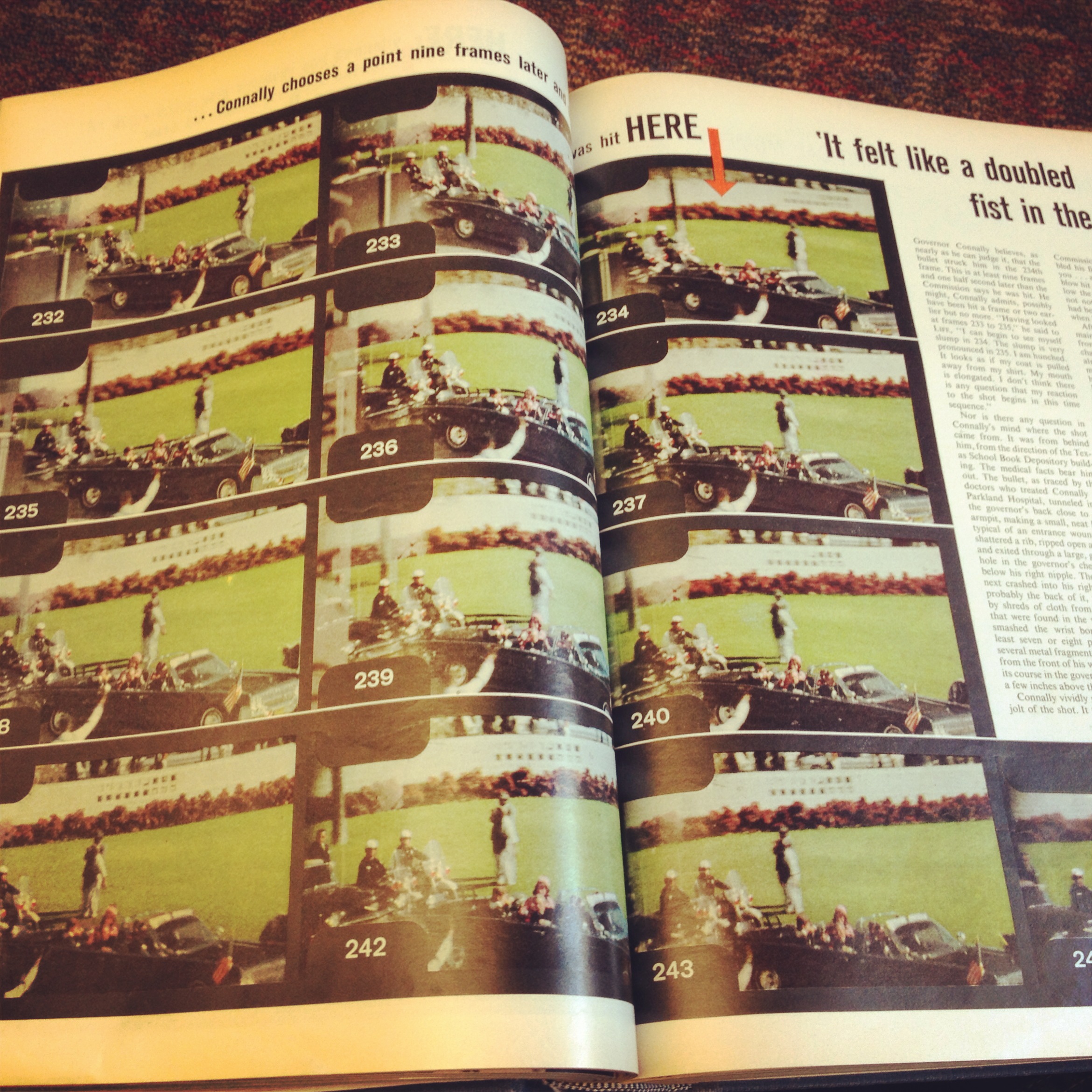
Figured I would wander to my favourite spot in the library: magazine back issues! Specifically the LIFE Magazine section. Managed to find the original LIFE Magazine (Nov 26, 1966) that covered the JFK assassination.
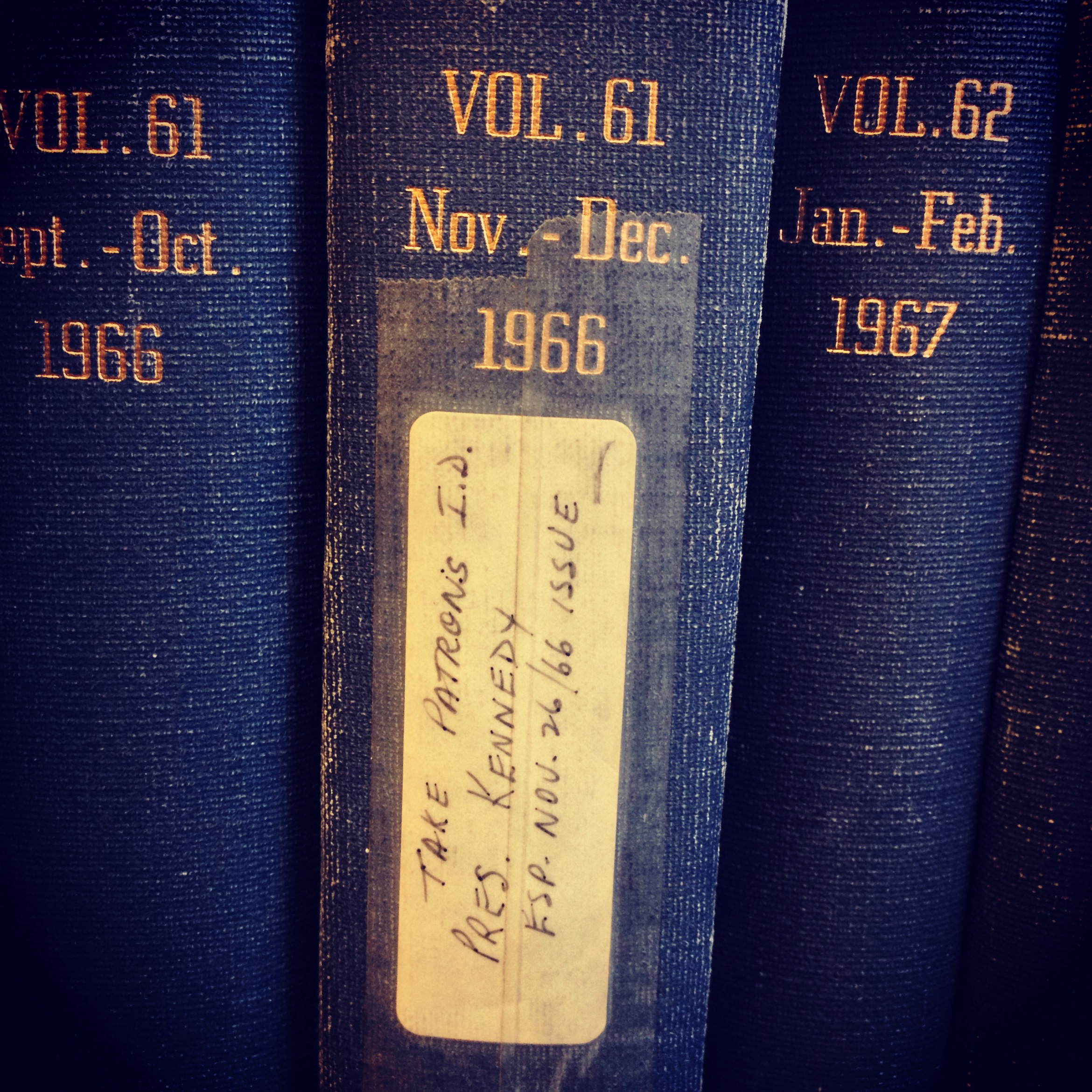
There was an old piece of paper taped to the side of the volume
Take patrons I.D.
Pres. Kennedy
Esp. Nov 26/66 Issue
The library received the issue from LIFE in 1966, so for all I know, that little piece of card stock could be 40 some odd years old! [That’s just a guess though. I’m probably wrong.]


You must be logged in to post a comment.